
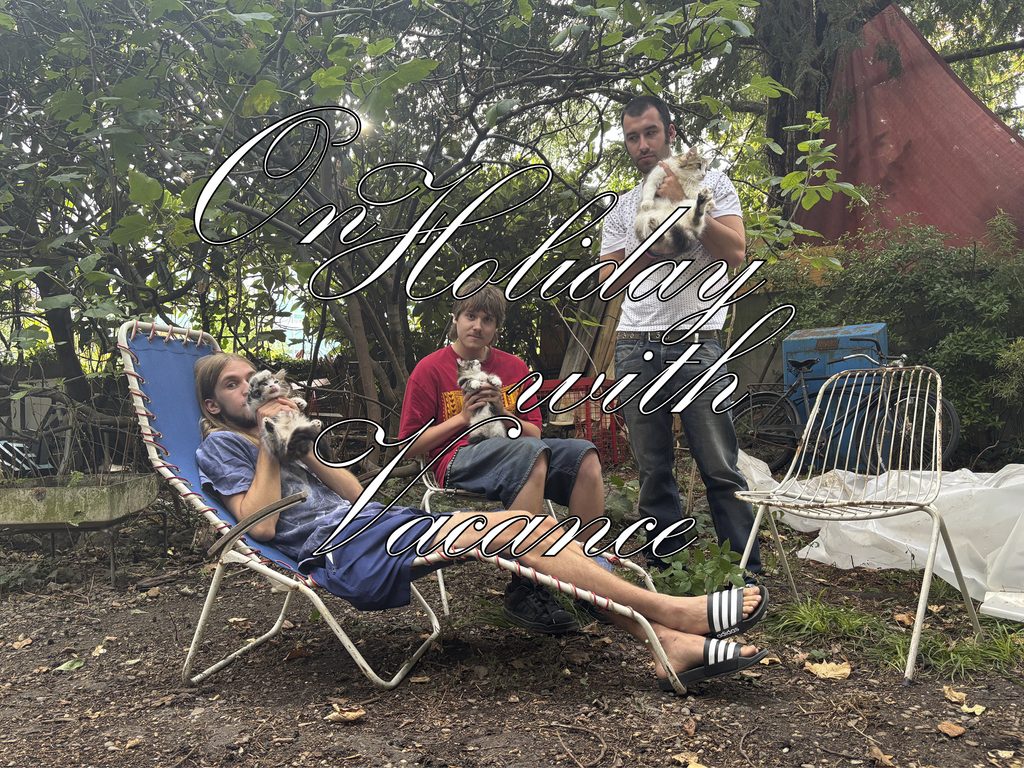
Summer may have been over for two months now, but the sun is always shining where Vacance are. If you speak French, or are learning it, you probably think straight of vacances: usually written in plural, it means ‘holidays,’ and instantly evokes something light and enjoyable. Even better though, Vacance is the Swiss-based label and collective founded and run by best friends and artists Louis, Oïva and Mateo – also known as Hashtaga, Ukk0o0 and Rosell Kid. Vacance originally stems from the region’s reference in hardcore music and late 2010s bunker and field free parties. Today, that shift is rather in electro spiritualism, infinite IDM love, garden parties, and something a little more administrative (well, legal).
Spending most of their time in Vevey – a quaint, pretty lakeside town in the Swiss-French part of the country, and also Millennial haven (understandably so) – Vacance produces, digs, selects, makes, organises. One thing Coquetas have in common with Vacance is taste, which is where we find each other halfway.
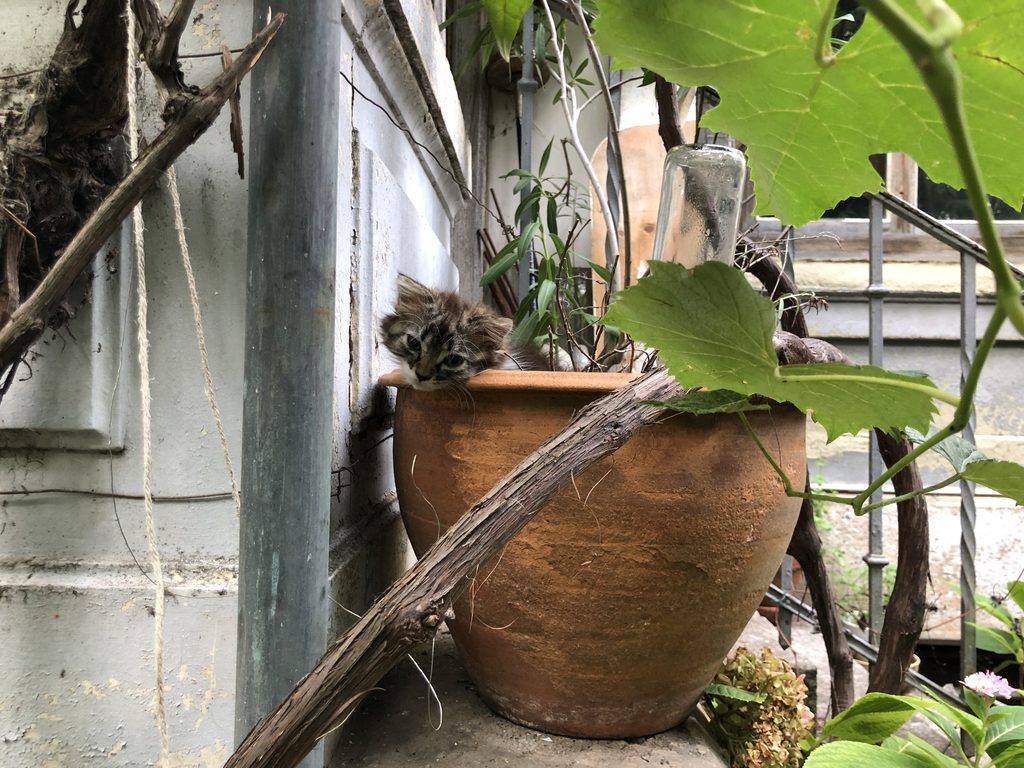
I sat down with Vacance in Oïva’s beautiful garden for our second Coqueteo, to get the scoop and snatch the label’s first-ever interview – we know there can only be more to come. Between Estate, coconut water, kittens hiding in flower pots, flicking lighters and a studio visit that felt like a gold mine, I learnt about the great S debate, the dream Vacance Festival line-up, and their favourite popstars. By the end of your read, we know you’ll be yearning for more.
Coquetas: Let’s begin with our usual background check, please introduce yourselves.
Mateo: My name is Mateo Vermeulen, I’m 23 years old. I studied photography in Vevey at the CEPV. I have one dog, one sister, and amazing parents. I live in a small town in the countryside, Poliez-Pittet, but I’m mostly in Vevey. That’s where I feel the best.
Oïva: Oïva Vermeulen, 24, I live in Vevey.
Louis: Louis, I’m 26. I’ve been living in Vevey for two years. I’m from Aigle and I work in social work.
How did you all begin your music journeys?
Oïva: I was 14, and I was just using Garageband on my phone. I used to just add loops from the app, and I was assembling them like Lego pieces. Then I switched on my computer and I discovered you could use different samples from psy, house, jungle – basically anything you could mix.
In 2018, I began DJing with my brother, Aïto. Afterwards in 2018–2020, there was the initial trigger, when I was part of the collective Manareïm which was created by Louis, my brother, and some other of their friends. I kinda started following what my friends were doing, so I began doing hardcore too. And at the same time, a friend showed me Aphex Twin so it was a mix of IDM, hardcore and ambient.
Mateo: Oïva’s brother was organising a lot of free parties, and I was always very close to them. I started going out [with them] when I was 14, which is when I discovered electronic music. One day I randomly tried out Aïto’s turntables in his room, and thought it was nice. A week later there was an event in a squat [in Hauteville], and at 4am, Aïto told me to go DJ. It was the first time. I was like 15. It was a very safe place to start.
Oïva: It was pretty much the space where all of us started DJing. Hauteville was the ‘trigger’ for many people; there were parties every weekend.
Mateo: Then I started going to CEPV, so once a week I was sleeping over at Oïva’s, and I’d just see him on his phone making stuff. At the time, music seemed like something you had to study, it seemed inaccessible. But seeing Oïva doing it – just as if he was playing a video game – made me realise how accessible it actually can be.
Louis: I began by DJing. I hung out a lot with my brother’s friends who were DJing when I was like 14, which made me want to mix dubstep and similar stuff. Then I started producing trap beats, and I was digging so many samples on YouTube. I wasn’t even making any melodies, I was just taking some samples, adding a trap pattern and some Migos acapella.
Louis, you were posting them on YouTube?
Louis: Yeah, they’re still up there actually. And on Soundcloud. It wasn’t anything crazy, but it was still something. Then one of my brother’s friends put us onto minimal and techno, which was kind of my electronic music revelation. I really got into industrial techno when I discovered it at raves – it drove me insane. Then I began trying to make some, and the more I listened to music, the more I wanted it to sound ‘harder,’ so it was techno, industrial hardcore, hardcore, tempo, speedcore, etc.
Oïva: Until you reach the limit.
Louis: There’s no coming back. So from 2018–2024, I mainly did hardcore music. I had an alias called Hlodowig Ekdahl. [We’ll come back to that later]
Tell us more about your time with hardcore and the late 2010s free parties.
Louis: It began when a friend, Pablo, held a fashion show here in the garden, and there was Karim, one of my best friends at the time with whom we’d go to free parties. And the number of times we stayed up until 4–5am, and the music playing was good, but it wasn’t really matching what we wanted. So after the garden show, we were like, ‘Shouldn’t we make a collective? Who wants to be a part of it?’ So that’s how Manareïm was born, and how we started organising our first free parties. The first one we held was in Allaman in 2019, in this sort of bunker where they’d put sheep in.
Mateo: At that time, it was pretty much prime time for Manareïm to be created. Every weekend there were free parties. Police today are way more onto it, so organising them isn’t as common as it used to be. Actually, initially, Vacance was Manareïm, it’s a sort of extension of it. In Manareïm, there were around 15 people – some didn’t do music.
Oïva: Manareïm was kind of the reference [for free parties] in the canton at the time.
Vacance’s first post goes back to May 2023. What was the switch like, going from Manareïm to creating your own label?
Mateo: At the beginning we were thinking of it as a label, but we also wanted to be able to organise more legal events in clubs, for example, fewer free parties. Even though it’s still part of our culture, we preferred shifting away from this aspect. They also offered us to join Cheatkode [Manareïm’s extension], but we decided we’d rather help out and invest in the legal and label aspect, as all three of us want to live from music. If you want to live off free parties, you can, but it’s a very different lifestyle.
Oïva: For us, it was mostly about releasing music by artists that we like, and organising events with them. In Manareïm, as we were way more, it was harder to find common ground. Creating a new entity meant making something that really is ours, and we could put the attention where we wanted to. And our creative direction was different from what Manareïm was offering. Laura [Aebi], who was also a member of Vacance at the time, used to be the label’s graphic designer – she had her own visual identity, which was breaking away from Manareïm’s free party universe.
Mateo: Manareïm had this very industrial feel to it. Even the name Vacance is more joyful and child-like. Even though we released more hardcore tracks, now we release a bit of everything. We liked the idea of doing hardcore but having this ‘lighter’ name.
How did you land on the name Vacance?
Oïva: We struggled for 4–5 months to find a name. You know, there’s always a point where you take each founding member’s letters and try to find something…
We took the first letter of everyone’s surname – Vermeulen, Atkinson, Cattin, Aebi – and it was ‘Vaca,’ so we thought we could make something from that, and then Vacance appeared pretty fast. Then the next debate was whether we add an S to it or not. [Dyllan Atkinson was also a member of Vacance at the time]
Mateo: It was such a long debate.
Louis: Especially between the two of you.
Who wanted the S?
Oïva: I wanted it. Well at first, graphically, the word looked way better without the S, but with the S it added way more sense. The debate was: would we rather have a visually ‘more beautiful’ name or have a name with more meaning? But we landed on the S-less version.
Louis: It’s like a proper noun.
Oïva: In French, you have la vacance, as in a vacancy.
Mateo: We thought it’s cool because still today people think we made a typo. So it’s also a way to have them remember the name, without an S.
Louis: It’s our marketing. [Laughs] We organised an event at RKC [Rocking Chair Vevey, a music venue] and called it C’est les Vacance [‘It’s the Vacance’], and people obviously thought we made a typo.
And do you have any criteria when having an artist release a project with the label?
Or is it purely what you like?
Oïva: Since we’ve always been inspired by so many musical genres, Vacance was a way to release whatever we like, without a genre limit. So the first criteria is that we like it, then that it’s accessible with our current status as a label, as not everyone agrees to release under a label not that well known. Generally, we’re looking for smaller artists.
Louis: Also we don’t really have a choice, we couldn’t just ask Arca—
Mateo: But there are also bigger labels looking for emerging artists. We’re not just choosing smaller artists because we have to do it, it’s also that we love doing it.
Oïva: If we can imagine the person on Vacance, we love their music, then we contact them.
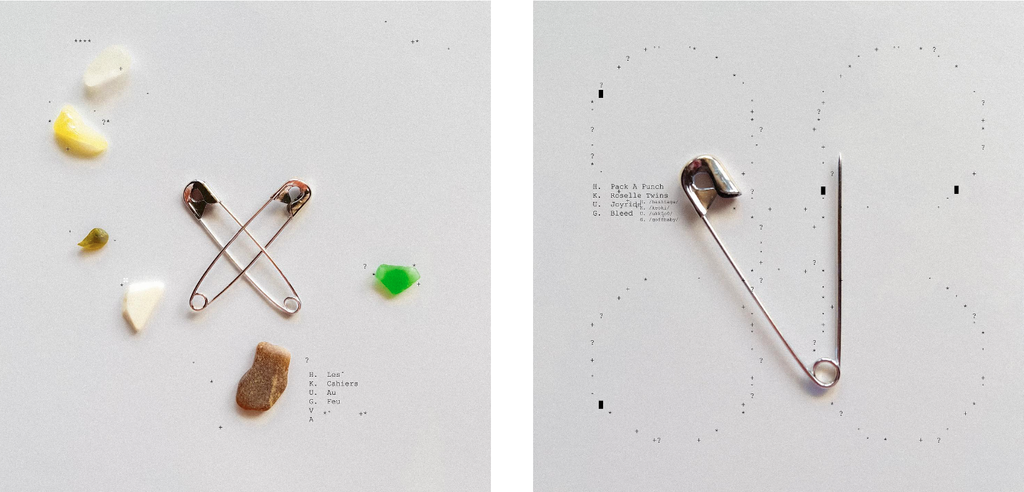
When I was going through your Instagram there was a very specific visual identity, even for the singles released by artists – which I guess Laura did. Now it seems like the artists’ provide their cover?
Louis: Yeah, Laura did everything.
Oïva: Now for singles, we’ve decided to number them, so 1, 2, 3, 4, etc. We ask the artist to take a random picture where we can guess their number. For example, there’s a cover with a piece of bread, and a three is drawn on it with ketchup. The goal is just to have the number hidden, or not, on the cover.
Mateo: Also it was during a time when the label was a bit on pause, and we were like, ‘Let’s just release stuff without overthinking it.’
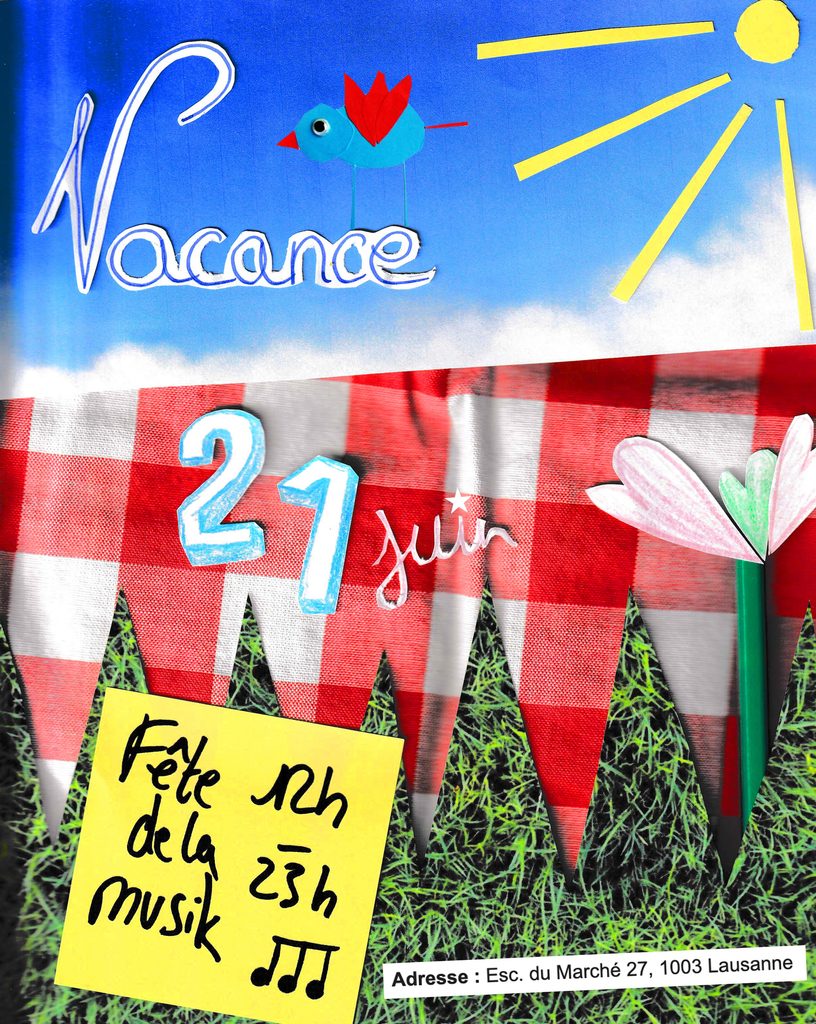
Louis: And we’re also doing it. We started making our own flyers – we love doing it.
Oïva: We really told ourselves that with the name Vacance, you can do whatever you like, more childlike stuff. But the name just gives us credibility to make ‘uglier’ stuff.
Mateo: That’s not true; they’re not necessarily ugly. For example, the flyer for fête de la musique was just a huge collage. We spent the afternoon cutting out stuff, drawing, and scanning it.
Oïva: Just as if you were in art class in primary school.
Mateo: For me, it’s one of the best flyers we’ve made.
You also released an advent calendar and a sample pack around Easter (Sample Pâques; Pâques means Easter), either for free or at a fair price. Does that come from an active desire to democratise electronic music and share it with a wider audience?
Oïva: We’re trying to make up for a lack of electronic music promotion in Switzerland – or at least the type of electronic music we like.
Mateo: We’re not doing it specifically for Switzerland, though. It’s just because we love music. I’m not, like, all proud, ‘Yeah, we’re a Swiss label.’ We’re just a group of friends who have a label. We’re Swiss, so sometimes we play with that, but there isn’t an idea of Swiss music promotion.
Oïva: We’ve only released one project by a Swiss artist, actually. Our audience has never been mostly in Switzerland, but mostly in Belgium, Germany and France. In Switzerland, it seems there’s always a little delay compared to other European countries. Maybe it’s more of a thorn in the foot to be a Swiss label, but at the same time, it’s also a strength.
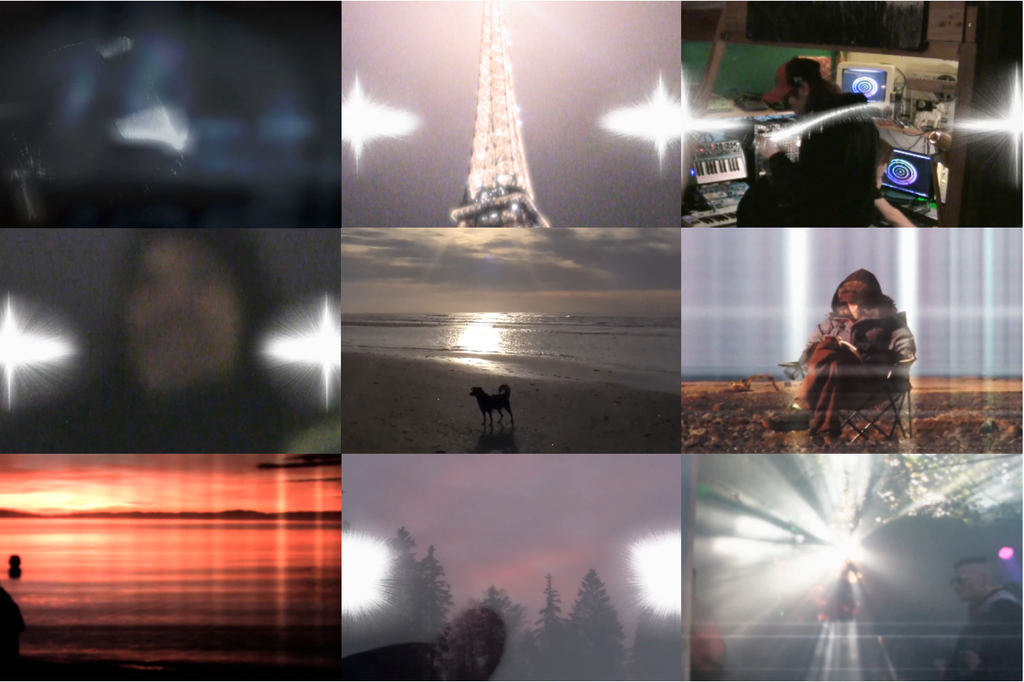
I did my homework and listened to your individual tracks. I selected my favourite one from each one of you, and you’ll have to give me a background story – personal or technical – about it. Mateo, I’ll begin with you. I chose Ambre.
Mateo: So at that time, when I was in my last year of my photography diploma, I was about to do an internship in Paris. Before I left, we saw Justice at the Montreux Jazz [Festival] – and I think I can speak for all of us, but it was a sort of ‘revelation’ in electronic music – and it made me realise how there’s a music genre that can make all generations dance. There were people in their forties, 5–6 year olds, people in their sixties, and people our age. And everyone was so into it. After that, we’ve all become super inspired by that.
Then, I got to Paris, set up my equipment, and it’s the first track I made when I arrived. I was like, ‘I just saw Justice, just got to Paris, I’m on cloud nine.’ So I made this more ‘experimental’ track – I wouldn’t call it purely electro. Then I did the music video with Maïa. I film a lot of stuff on the camcorder, and she does visuals on TouchDesigner, so I was like, ‘Let’s do something collaborative, you can do your experiments and I’ll send you footage.’ The visualiser actually took so much time to make because it was more of an ongoing experiment. At some point, we decided to just stop there and post it. It works well with the track.
Fabulous, thanks Mateo. For you Louis, I chose Candy Thief, spill.
Louis: Wow, you chose well, it’s a good track. At first, I was supposed to release it under my alias Hlodowig Ekdahl. I produced this track in 2020 when I felt more limited by my influences at the time, and so I made the alias inspired by the whole IDM scene, and began producing more ‘chill,’ melodic music. I was very inspired, so I produced a lot of tracks. Two years later, I released an album with 25 tracks, and I didn’t release Candy Thief – not on purpose. A few years after that, I was on my computer and I stumbled on it, and was like, ‘Fuck, it’s so good.’ I wanted to release another album for Hlodowig Ekdahl with this as the initial inspiration, but it never happened, and I decided to stop the project as I wanted to centralise everything under Hashtaga. I didn’t really change anything – I didn’t have any of the plugins.
Oïva: He’s not well organised.
Louis: Most probably. So I released it under an EP with a bunch of other tracks I really loved. And I love this track, it’s really great. I was happy to randomly find it again, and publish it four years later.
What’s the story behind the name Hlodowig Ekdahl?
Louis: Hlodowig is the oldest root of the name Louis. Then I wanted to have two names, so I went on a Swedish word generator website and it [Ekdahl] sounded good.
Now, Oïva, for you, I chose This Morning.
Oïva: I think I did it in one day. I woke up early – for once – and I began making music, and it was a period where I wasn’t producing so much… We all have phases, for a week, a month, two months, where you just can’t produce anything. But then that morning, I did the track. I posted it on the exact day. It was literally like, ‘This morning I made a track.’
Louis: I love this track.
Oïva: I remember it was also the time when Louis was beginning to sing on his tracks, and it made me wanna do it too. But I don’t like using a microphone; I hate hearing my voice. And so I took a mic, but added lots of effects on it. It didn’t work to have clear lyrics so I just cut out bits of them. So there’s this melodic-distorted voice that makes up the main melody of the song.
You all kind of got into it, but what’s your work process like?
Oïva: It really depends on each song. At least for my routine, everyday I open up Ableton and either I continue working on a track, or when I’m getting sick of it, I begin another project. If the project works like This Morning, it can take a day and is easy to make. But those are super rare cases, it’s like the 0.1%. In music – at least for us – to release one track, we have to open up 30–40 projects. It really depends on the song. I have tracks I’ve been working on for four years – still not released.
Mateo: It’s also about research. For a long time, I was too attached to a project so I’d try to save it, and would focus too much on that. I’ve been trying to deconstruct that – and Oïva has helped me a lot with it, he has a good work methodology. You also have to put yourself in a creative state, and sometimes, having a routine helps. Like, I wake up in the morning, have a shower, make a coffee; I know my day begins. Then I’ll open up my laptop and start working on a song. Now for example, I’m much more creative during the night, so I’m up until 4–5 in the morning.
Oïva: Depending on the time of the day, the outcome of what you’re working on will be very different. And when you’re producing during the night, you’re kind of in your own bubble, people are already sleeping, and you can spend hours and hours on it. But during the day, you see time going by, you can situate yourself in time.
Louis: Since I changed direction, my way of producing is extremely different. With hardcore, I could spend weeks on a track because there are so many elements. Now that I’m making ‘simpler’ productions, I have to find catchy elements, write lyrics and sing over the track. But recently I’ve told myself I won’t overthink the finality of my tracks, and just release them when I like them, without needing an EP, an album or a music video. That’s helped me detach from the serious side of music, and I’ve been producing way more. I do all the creative aspects myself, then send it to Oïva for mixing and mastering. We also do a lot of music together.
Yeah, Louis and Oïva, you recently released the Happy with a secret and its music video.
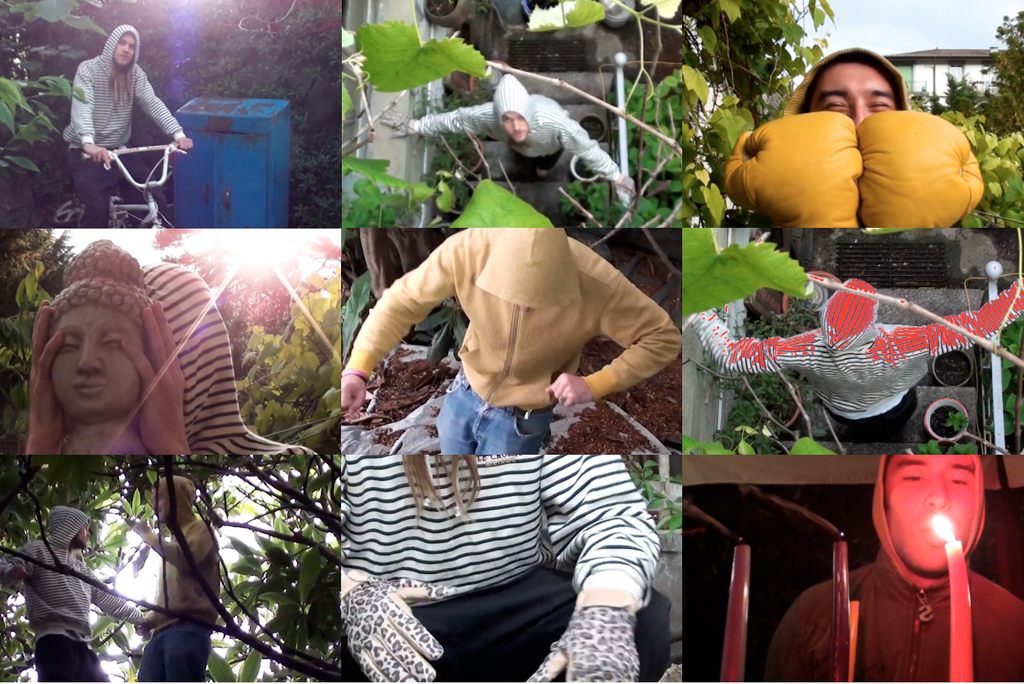
Louis: One afternoon, I called him to see if he wanted to make music, and we were inspired by a Soraya Cinema track. And we began working on the production, and everything just fell into place so naturally. So we decided to finish it during the night and make a music video. Since we’ve made that we haven’t been able to find that again.
Oïva: We also had a different creative approach compared to before. Happy with a secret was also a trigger in regards to what we want to be doing more of. And the amount of times where Louis came over to make music, and just nothing works, there are just too many times to count. That was the type of track you do in one day. Before finishing the production, we went to the garden and filmed the music video, then we picked the track up again, filmed a little more, and then we were done. We began editing the clip – and Louis fell asleep super fast at 1–2am. Then he wakes up, and I was almost done with the editing and was so excited, he watches it still half-asleep.
Louis: The next day you sent me an updated version, and we uploaded it that evening. I think I’ve never listened to a track on loop that many times – and well we filmed a video. It would start over again, and we’d go crazy.
Okay, cliché question, but I must ask: What’s Vacance’s dream holiday?
Oïva: A dream holiday. I think… somewhere by the sea coast, somewhere calm, but with lots of little ‘intimate’ superettes [convenience stores], where you’ve got the guy who’s been working there for 30–40 years, and he’s got all those local products, and the sea is right there. You go out in your slides and shorts, towel thrown over your shoulders, you go to the beach, have an ice cream, you go back home, have a nap before the restaurant – and you’re with friends, that’s the most important.
Mateo: Basically resting.
Oïva: Yeah, mega resting. And at the same time, maybe there’s a party somewhere.
Mateo: Yeah, I’d say my dream holiday is where nothing is really planned. Either like Oïva, where there’s this super relaxing aspect about it, or the opposite where you do a bunch of different countries with a backpack and follow the flow. Like, if you decide you want to stay for a month in the country, you just do it. But if you wanna go somewhere else, you just get carried away.
Oïva: You get into side quests…
Mateo: Yeah exactly, you meet a bunch of people, you never know how you’ll end your day.
Oïva: Something very simple, like you get something to eat, sit down on steps for an hour, do some people watching.
Louis: One of my best friends is a tattoo artist, and he’s made friends in London. What I love is travelling to a country with locals. They’re the ones who take you to places they know, you meet so many people, and whatever you do, you’re just having fun. It’s more spontaneous, like you end up at parties you’d never have gone to otherwise. Whatever you do is cool, because you’re with cool people. But I wouldn’t say no to the sea either.
Mateo: There are too many types of dream holidays.
Interesting, no one said a specific destination.
Mateo: It’s more about energy than a place.
True. Now, Vacance is organising the Vacance Festival. What’s the line-up?
Louis: Ohhh shit…
Oïva: We’ve asked ourselves this question so many times.
Mateo: How many artists?
Let’s do five.
Louis: Five artists?! That’s rough…
Mateo: You know what, we have to either put Venetian Snares or Aphex Twin…
Oïva: For me, for sure we’re having Aphex Twin up there.
Mateo: And why not Justice.
Louis: [Laughs]
Mateo: Wait, alive or not?
They have to be alive.
Louis: It’s so hard to think like that, there are too many artists…
Mateo: Do we lock Justice, or? We put him on the side for now.
Louis: [Laughs]
Oïva: There’s this thing where I need the person to have done projects which have moved me for a long time, for me to put them in my dream line up. Aphex Twin is for certain. We’re allowed two stages?
Yeah, yeah. Main stage and a smaller one.
Louis: Imogen Heap.
Oïva: Ouhhh yeah. I’d love MGMT.
Mateo: Yes. And for the smaller stage…
Oïva: Pink Floyd are still…
Louis: [Laughs]
Oïva: They’re still touring?
Mateo: They’re main stage.
Oïva: But are they still touring?
Mateo: I don’t know…
Oïva: Oof, Daft Punk!
Mateo: Daft Punk for sure. We have Daft Punk’s comeback at our festival.
Oïva: Aphex Twin, Daft Punk – that’s certain – MGMT, …
Louis: Imogen Heap. It’s hard.
Oïva: Air would be sick.
Mateo: Yeah, but I don’t know if I’d put them on the line up. But for the second stage, we could do a little Sebastien Téllier.
Oïva: Ummm. I love a lot of his tracks but not all.
Mateo: Yeah, I see.
I feel like you’re pretty set for the main stage though with Aphex Twin, Daft Punk, …
Mateo: Boards of Canada!
Oïva: Mhhm, yeah. For the second stage.
Louis: We’ve got Aphex Twin. What do you mean we put him on the second stage? Boards on there?
Mateo: Yeah, like an intimate stage. Empire of the Sun would be cool too, but no. Vitalic!
Oïva: No.
Mateo: No?! Stop…
Oïva: Ohhh, how about Chief Keef on the main stage?
Louis: [Laughs] Oh fuck, yeah.
Mateo: Speaks to me. Alright so Boards of Canada for the second stage, do something more immersive.
Louis: No, no…
Mateo: You don’t see them as the second stage?
Louis: Yeah, but no…
[5 minutes later, I’ve granted them a sixth act and they’ve come to a reasonable conclusion]
Mateo: Let’s recap: Aphex Twin, Imogen Heap, Chief Keef, Boards of Canada, and Daft Punk.
Louis: I’d rather have MGMT over…
Mateo: Ok no, we do six and we have MGMT. Honestly, wild line up. And we get the Daft Punk comeback. That speaks to me.
Louis: And we do pay-what-you-want tickets – super important. Everyone can come. And must come.
And where are you having the festival?
Louis: We rent a city.
Mateo: I’d love a beach.
Oïva: That spot where Pink Floyd did Echoes. Pompeii.
Louis: Ahhh, but it’s not big enough. We need hectares.
Oïva: My goal is to have a good 100’000 people.
Mateo: I don’t think I’d do it in the city. What about a huge forest with humongous trees
that are like 20 metres tall. We could do crazy projections during the night.
Fuck, I’m so into it.
We’re waiting for it now. You have to do a feature with an artist who’d make your career blow up – think wisely. Who do you choose?
Mateo: Fuck, that’s hard too. Daft Punk? [Laughs] If they’re coming back, then Daft Punk.
Louis: We need something realistic.
Mateo: Then Justice, why not.
Oïva: I think Justice too.
Mateo: You can do so many different things with Justice.
Louis: It’s hard.
Mateo: Maybe Tame Impala, too. All the features he’s done are so good.
Louis: I’m staying on Imogen Heap.
What’s your guilty pleasure song? Like, it’s almost an embarrassing listen to share.
Louis: It’s impossible I’m embarrassed when listening to something.
I’ll give you an example: I have a song I listened to on repeat back in December, and it’s a little embarrassing, to be honest. Do you know Rommulas? He has this song called Mami. [I showed them the track, they understood]
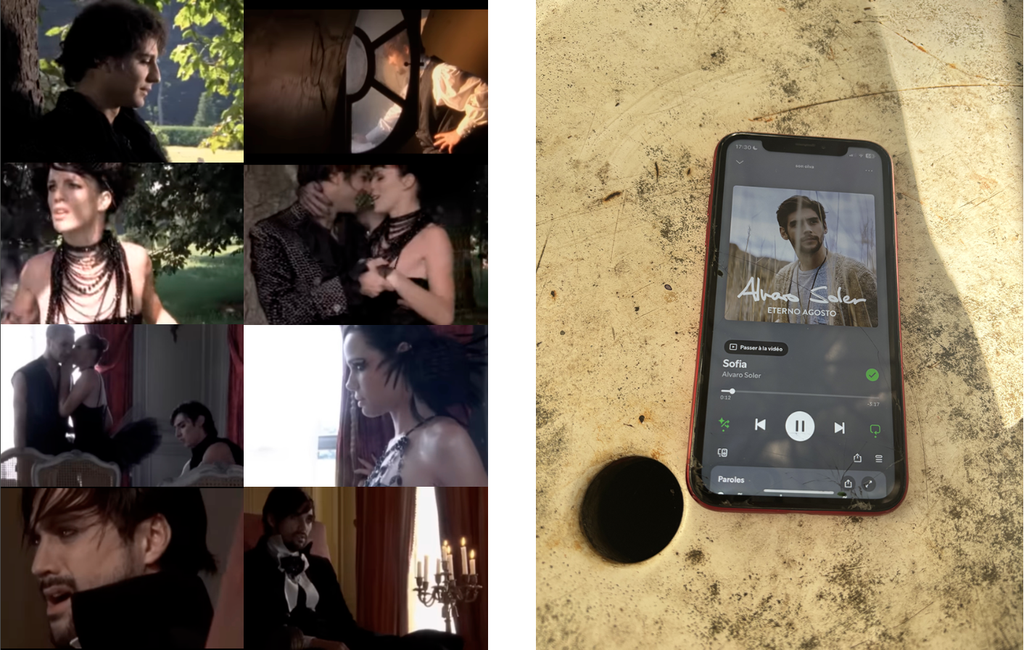
Oïva: My guilty pleasure…is Sofia by Alvaro Soler. I love it.
Mateo: Okay I choose L’Assasymphonie de Mozart Opera Rock.
Nooo, it’s good.
Mateo: It’s so good.
Oïva: Yeah in guilty pleasures, I’ve got lots of French music.
Louis: The thing is, I don’t think I have any tracks I wouldn’t admit to listening to.
Oïva: Guilty pleasure, but more when you’re in your feels, and you listen to it. More than something shameful.
Louis: I’ll say Leach by Cryogeyser. It’s so intense. It’s a really great track if you want to cry. [We didn’t listen to it collectively]
Do you have a current favourite popstar?
Mateo: So I don’t have a favourite popstar but I have a favourite celebrity couple: A$AP Rocky and Katy Perry.
Louis: And Katy Perry? [Laughs]
Mateo: Fuck, that would have been a good mashup. A$AP Rocky and Rihanna.
Louis: iKeda, tbh. Theo, one of our best friends, showed me her. She’s not that famous, but she’s already a true pop star.
Her music videos are so good. You, Oïva?
Oïva: I adore Lana del Rey. I love her vibe, this thing she emanates, this whole sad girl thing. It speaks to me. [Laughs] Also her journey, at first she’s this very melancholic girl, now she’s all happy with her 50 year old man. I love it.
I was wondering about your current inspirations? Not necessarily of all time, but with your sound evolving, who’s also inspiring that new direction?
Oïva: With Louis we’re very inspired by Soraya Cinema. And another inspo we have is ear.
Louis: Yeah, huge inspo at the moment.
Mateo: I think it’s by phases. After seeing Justice, we were super into French Touch, so we were all digging in that. I was super inspired by SebastiAN, Justice. Then I was very inspired by old ‘mainstream’ electro like dedmaus5. I think Justice are the ones who’ve followed me throughout time, they have so many different albums. I’d say it’s mostly old albums. Also if we take Pink Floyd, it might not be directly in our music, but it’s there and it’s inspiring us in its energies or intensities.
Louis: Actually, I watch a lot of films, and there are many lines I write down to sing them, so it’s a huge inspo as well, whether the visuals or dialogues. Also my friend Hal, 300SkullsAndCounting, has an excellent and super inspiring way of promoting his music – he has his music remixed by 5-year olds, does shows where he counts to 300 before beginning his concert, or he sings lying down in the crowd.
Mateo: If we imagine our dream live set, there’s an intro, a beginning, an outro – basically a whole thing. It wouldn’t just be us arriving and starting to play. We’ve thought about it many times, like us arriving by helicopter, smoke generators and all. It’s a full show.
Oïva: What inspires me – like Louis said – is not necessarily an artist, but rather the electro scene and how it branches out into so many genres, like folk or rap. There’s this thing of freedom, where you can make ‘wtf stuff,’ and everyone is free to do whatever they like. If you take Bassvictim or Worldpeace DMT, they have some shows where they’re just all sitting in the crowd and singing together, and they bring a lot of acoustic elements to their electronic music. Also that way of performing where you don’t need to be singing well or playing an instrument well to make something good. That’s what’s inspiring me.
We spoke a lot about music but when you’re not making any, what are you into?
Oïva: I go to the lake.
Louis: I watch movies or work.
Mateo: I play a lot of video games.
Oïva: It’s often an extension of music, though. If I worked on a song the night before, I would go to the shore, go to my usual spot, do some sound checks, smoke a joint, and watch the sunset.
Louis: I hang out with friends.
Mateo: It’s important for creativity, too. The amount of times you’re outside and get an idea.
You just never stop. What’s next for Vacance?
Oïva: My dad’s album. [Coming out on February 15 2027]
Mateo: First album on vinyl.
Oïva: My dad has had a lot of impact on me, and probably also directly on all of us. His philosophy in the way he sees music too. He’s always done music too, before he was 20, he began with punk, then he started recording lo-fi on cassettes. We’re the generation that grew up with a computer, we’ve always made music with a software and you see a lot what you do, and you can quickly get lost. Because what you see is not necessarily what you hear. And my dad has always instilled the idea of using your ears.
Mateo: We were lucky to get this ‘ideology of the ear’ from your dad, because a lot of people are like, ‘Until I don’t have a mix and mastering on my track then it isn’t good.’ His dad also brought this thing of ‘If it sounds good then it’s good.’
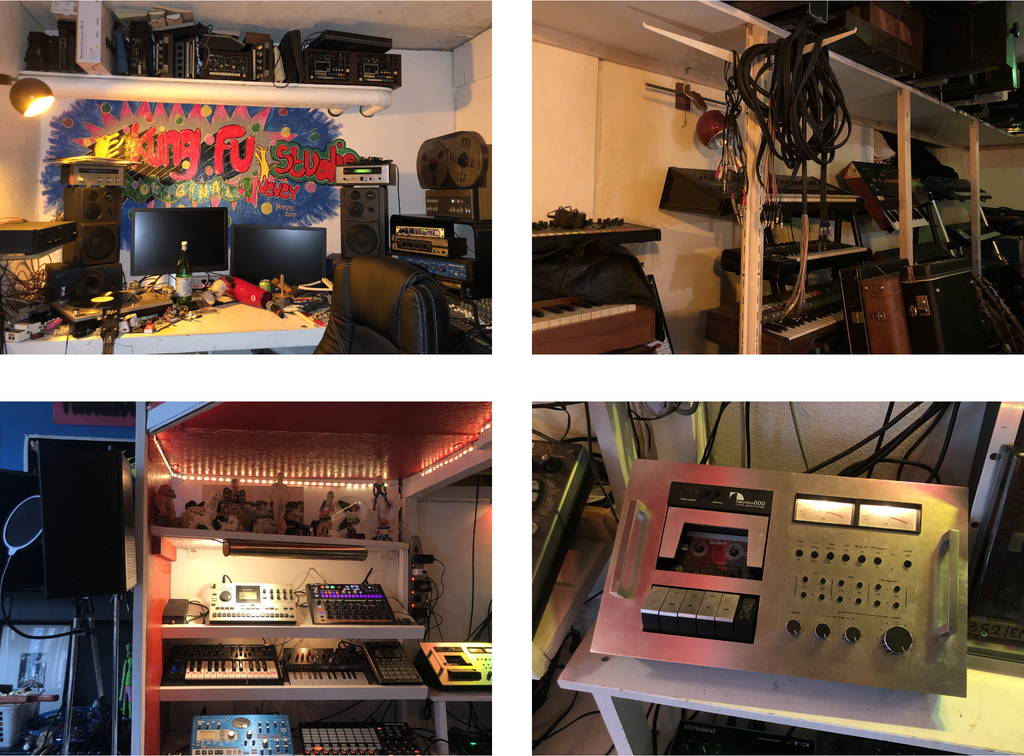
Oïva: He records his drums with the mic of his mac. He does with what he’s got. He’s always had so many machines. It’s thanks to my dad that I have a studio in my room.
Mateo: You can just go downstairs and take some machines.
Louis: It’s pretty insane.
Oïva: The tracks from the album go back to 17 years ago, basically between 2009 and 2026. It’s music I’ve been hearing since I was 8 years old. When we made the label – Louis and Mateo have always loved my dad’s music – we were like, ‘We should release your songs otherwise you’ll never release them.’ He really does music for himself. Releasing his work pisses him off, he hates all the admin work.
Louis: And there’s a crazy potential.
Mateo: He mainly does dub, but the album is electro, and only. Vacance is also working on releasing more singles.
Last but definitely not least, in Coquetas’ tradition, our interviewees must give us a secret.
Louis: I only used the white keys of a keyboard for the totality of my productions from the start until last year. Zero black keys.
Oïva: My secret is that in my studio, apart from my computer, I didn’t pay for anything. It’s contributions from all my entourage
– mainly my dad, but also Mateo a lot.
Louis: Mateo’s secret is that he’s a nepo baby.
Mateo: What could I say…
[Mateo got five extra minutes to find his secret]
Mateo: My secret is that I knew only one of my grandmothers.
Oïva: That’s not a secret.
Mateo: I had to change my artist name because I was threatened with a lawsuit. My old alias was Keoki, which is my middle name. My parents used to travel a lot, and when my mom was pregnant with me they were in Hawaii, thinking of a middle name. At first it was George, which was my grandfather’s name, but they thought it wouldn’t age too well, so they looked up the Hawaiian equivalent, which is Keoki. There’s a Hawaiian DJ called Keoki, and as I was posting my work under my middle name, one day his agent emailed me about ‘fan conflict.’ A few of my tracks had ended up on his profile, so I had to change my alias. I had a track coming out a month later on a label, so I had to think fast. I had a huge Google Doc of ideas, and I kind of just landed on Rosell Kid at the last minute.
https://www.instagram.com/vacance.ch

Bisous, L